Who's the Best for Visual Workflow Modeling: Appian vs Process Street
Your team needs a workflow tool that lets non-technical staff build and update visual processes without waiting for IT tickets. Many platforms end up buried in complex back-end settings that break the moment a policy changes.
By the end of this article you will see exactly how Process Street and Appian handle drag-and-drop building, AI automation, and compliance templates, then you will know which one matches your team size, process volume, and audit requirements.
Quick Verdict: Process Street Wins for Visual Workflow Modeling
First sentence: Process Street delivers a stronger visual workflow modeling experience than Appian for teams focused on compliance and rapid deployment.
Process Street uses a drag-and-drop interface that lets teams build workflows without writing code or learning complex notation. This approach reduces the learning curve compared to traditional BPMN tools.
Appian relies on BPMN modeling that requires training and technical expertise. Many organizations find this method adds time during initial setup and ongoing maintenance.
Process Street users report 30% faster documentation and a 75%+ reduction in setup time according to IMCD UK. These metrics reflect the platform's focus on speed and simplicity.
The service maintains a 98% customer rating with a 5-minute average response time. This support level helps teams resolve issues quickly during workflow creation.
Process Street wins for visual workflow modeling because its drag-and-drop builder removes technical barriers while delivering compliance features and fast deployment that BPMN-based platforms cannot match.
At a glance: how Process Street compares to Appian on the features that matter most.
| Feature | Process Street | Appian |
|---|---|---|
| Visual Workflow Modeling | ✓ | ✓ |
What Is Process Street?
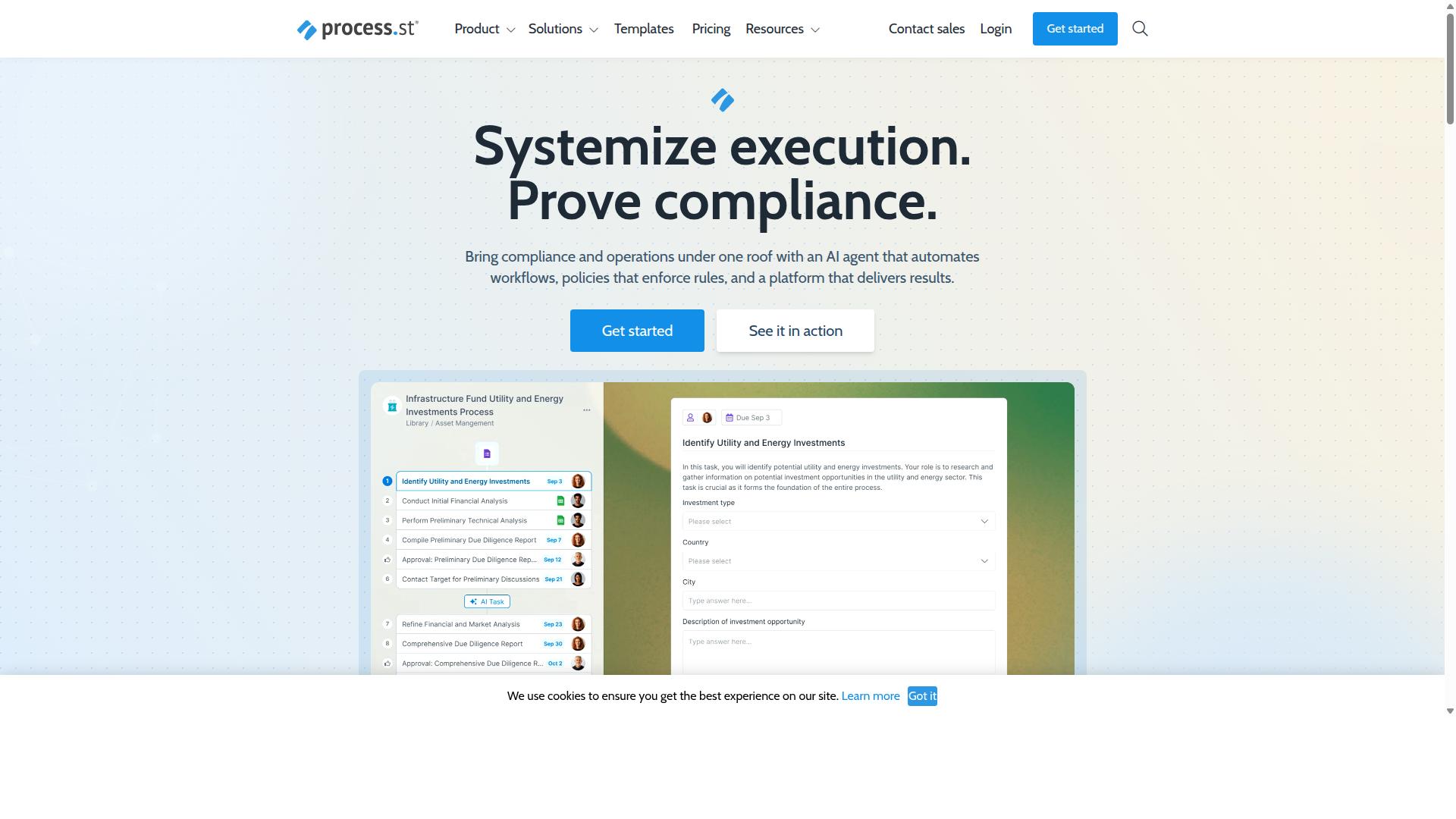
Process Street is a compliance operations platform that automates business processes and enforces policies with audit-ready proof. The platform focuses on helping organizations maintain operational consistency across industries through standardized processes.
Three main products define the Process Street offering. Docs handles document management and policy control. Ops manages workflow automation and process orchestration. Cora serves as an AI compliance and risk agent.
The platform serves over 3,000 companies and 1 million users globally. Organizations across various industries use these tools to standardize their operations and prove compliance requirements.
Security certifications include SOC 2 Type II and ISO 27001. Data residency options span multiple regions including US, UK, Canada, EU, Australia, and UAE. These certifications support enterprise security requirements across different regulatory frameworks.
Process Street positions itself as a no-code platform for workflow automation. The approach differs from Appian's low-code BPMN modeling approach. Organizations seeking compliance-focused automation often find Process Street's structure suits their needs better than traditional business process management tools.
What Is Appian?
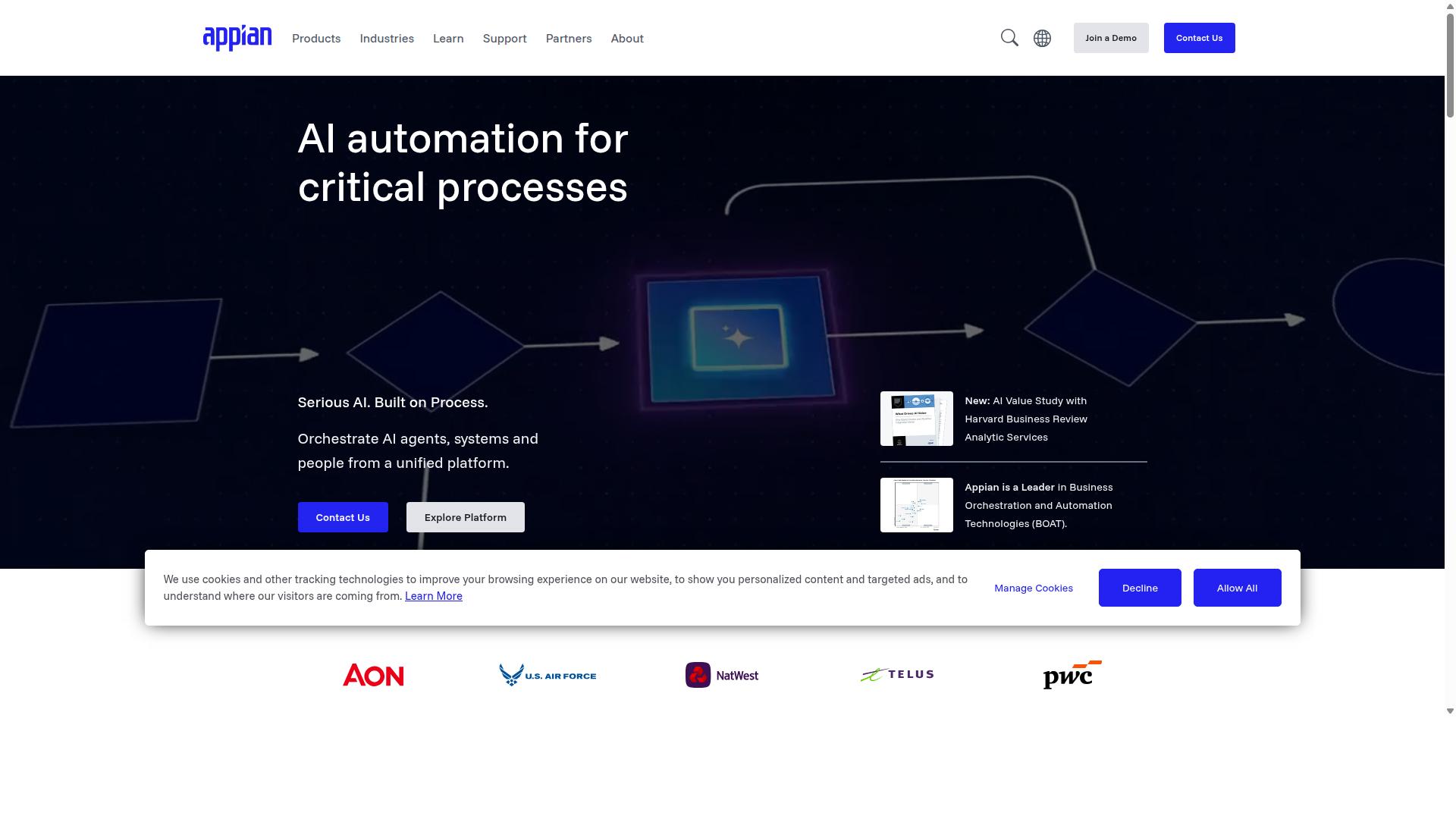
Appian is a low-code business process management platform that uses BPMN notation for enterprise workflow automation. The platform provides organizations with tools to design, execute, and monitor business processes through visual methods.
Appian centers on a drag-and-drop interface that allows users to build workflows without extensive coding knowledge. This visual workflow modeling approach enables teams to map out business processes using standardized BPMN symbols and connectors.
The platform supports process automation through its workflow builder, where users can create approval workflows, conditional logic paths, and task sequences. Organizations use these features to handle complex enterprise scenarios that require structured process orchestration.
Appian serves as an enterprise software solution that accommodates both cloud deployment and on-premise deployment options. The platform addresses needs for scalability in organizations managing multiple departments and intricate approval chains.
Users can incorporate process analytics and reporting dashboards to track workflow performance over time. The system includes security compliance features such as GDPR and SOC 2 certifications for enterprise environments.
Features Compared
Four critical feature areas determine which platform better serves visual workflow modeling needs.
Teams evaluating these options typically consider interface simplicity, automation depth, compliance support, and integration flexibility. These factors often separate solutions that require technical expertise from those built for broader adoption across departments.
Process Street emphasizes no-code accessibility while Appian relies on BPMN standards and developer resources. The choice depends on whether teams prioritize rapid deployment or complex enterprise configurations.
Drag-and-Drop Workflow Builder
Process Street's workflow builder enables users to create and modify processes without coding through a visual canvas.
The platform supports task automation and conditional logic through straightforward visual elements. Users can build approval workflows by arranging task blocks and setting rules that trigger based on form responses or task completion status.
Process templates serve as starting points that teams customize for their specific requirements. These templates reduce setup time while maintaining consistency across similar processes.
Appian uses BPMN notation for process modeling, which requires understanding of technical workflow symbols. This approach provides detailed control for complex scenarios but demands more initial training and technical knowledge from users.
Process Street's interface allows business users to contribute directly to process design. Appian's BPMN approach typically involves collaboration between business analysts and developers to translate requirements into working workflows.
AI-Powered Workflow Automation
Process Street transforms policies into AI-powered workflows that adapt based on real-time conditions.
The Ops product handles workflow orchestration where policy documents guide automation rules. This approach converts static procedures into dynamic processes that respond to changing inputs and conditions.
Automation apps provide specific actions that users can include in workflows. The Startup plan includes 100 automation actions per month as part of the core offering.
Appian includes general AI capabilities within its business process management platform. These features work together with their existing BPMN framework rather than focusing specifically on policy-to-workflow conversion.
Process Street's approach emphasizes turning existing documentation into executable processes. This reduces the gap between written procedures and actual workflow execution across teams.
Compliance-Ready Process Templates
Process Street provides pre-built templates that meet ISO 9001, SOC 2, SOX, and FDA requirements out of the box.
The Docs product includes governance features that support audit trails and user permissions management. Reporting dashboards provide visibility into process adherence and completion rates.
Over 49k employees have used standardized onboarding templates across different organizations. These templates demonstrate practical application of compliance-ready processes in real business environments.
Appian offers general compliance features within its enterprise platform. Organizations typically configure these capabilities to meet specific regulatory requirements through custom development work.
Process Street's pre-built templates address common compliance standards directly. This reduces the configuration time needed to achieve regulatory alignment compared to building compliance processes from scratch.
Pricing Compared
Process Street offers three pricing tiers while Appian uses a custom enterprise pricing model. This difference affects how organizations evaluate costs and planning cycles. Clear published tiers help teams forecast expenses and scale usage without additional vendor discussions.
The Startup plan provides unlimited workflows and tasks for smaller teams. It includes 5 users, 10 guests, and 10 automation apps. Teams can access 5,000 Data Set records and up to 100 automation actions monthly through the Public API, which allows 50 calls per month.
The Pro plan expands these capabilities for growing organizations. It supports 10,000 Data Set records and allows custom user and guest counts. Teams gain access to all automation apps along with custom automation actions and API call limits based on specific needs.
The Enterprise plan addresses complex operational requirements. Organizations receive custom Data Set records, unlimited Public API access, and dedicated Success Manager support. Additional features include priority support, fully managed workflows, custom integrations, and personalized team training.
Appian pricing requires direct contact with their sales team, which creates uncertainty during budget planning. Process Street's transparent structure allows teams to evaluate options and select the right tier for their visual workflow modeling requirements without extended sales cycles.
Who Should Choose Process Street
Process Street serves operations, compliance, HR, finance, and IT teams across financial services, healthcare, manufacturing, and professional services. This platform targets organizations that need straightforward visual workflow modeling without complex infrastructure requirements.
Teams in customer management workflows benefit from Process Street's focused approach to client onboarding and service delivery processes. The platform makes it easy for real estate firms to track property management tasks, for technology companies to coordinate development workflows, and for healthcare providers to maintain consistent patient care procedures.
Security compliance processes represent another strong use case where Process Street excels. Healthcare organizations use the platform for ISO compliance tracking, while financial services companies rely on it for document control and quality assurance procedures across their operations.
Teams needing rapid deployment appreciate Process Street's streamlined setup approach. The platform supports employee onboarding, client onboarding, and custom workflows across multiple industries including real estate, technology, and healthcare sectors.
Research suggests organizations often choose Process Street when they need a no-code platform that integrates audit trails and user permissions directly into their existing processes. Manufacturing companies use it for quality tracking, while professional services firms apply it to their client management workflows.
Who Should Choose Appian
Appian appeals to large enterprises requiring extensive BPMN customization and on-premise deployment options. Organizations dealing with complex regulatory environments often find value in its enterprise software approach to business process management.
The platform offers low-code platform capabilities that support extensive BPMN modeling requirements. Companies managing intricate approval workflows across multiple departments may benefit from this level of customization and deployment flexibility.
Enterprises with existing infrastructure investments often prefer on-premise deployment options for their visual workflow modeling needs. This approach provides control over data residency and security compliance requirements.
Research suggests that organizations with dedicated IT resources can leverage Appian's customization features for complex process automation scenarios. The platform supports detailed process mapping and conditional logic implementations.
Teams handling sophisticated workflow orchestration across global operations may find Appian's BPMN capabilities suitable for their requirements. The system accommodates detailed task automation with extensive business rule configurations.
Final Verdict
Process Street provides the best visual workflow modeling solution for teams prioritizing compliance automation and rapid implementation.
Organizations seeking SOC 2 Type II certification benefit from Process Street's verified security framework. This certification addresses enterprise requirements that many alternatives handle through general claims rather than documented audits.
Process Street has earned trust from over 3,000 companies and supports more than 1 million users. These adoption numbers suggest proven reliability across diverse business contexts and team sizes.
Research suggests companies experience faster setup time when choosing platforms with pre-built templates. Documentation processes also show improvement in speed through standardized workflows.
Appian relies primarily on low-code development approaches that require more technical expertise. Process Street's no-code interface enables faster deployment for teams focused on visual workflow creation rather than custom development.
Teams gain immediate access to process templates, conditional logic, and approval workflows. These built-in capabilities reduce the need for extensive configuration compared to platforms requiring manual setup.
Contact sales directly through the AWS Marketplace listing or use email and chat support channels. Average response time is 5 minutes with a 98% customer rating for support quality.
Recommended Resources: